
DarkMatter — verified market onion URL, mirror links
DarkMatter Watch is an independent, non-commercial reference site for the DarkMatter market: a Tor-based DarkMatter dark web marketplace that launched in late 2022 with roughly 95,000 registered users and 26,000 active listings on the DarkMatter darknet platform. The DarkMatter marketplace profile below is current as of the verification date above.
This page documents the DarkMatter market: its structure, its security model, and the PGP-signed DarkMatter onion URL that separates the real DarkMatter dark web site from the phishing clones that surround it. The address is published for harm reduction, not endorsement. The DarkMatter URL and each DarkMatter mirror link below are the only addresses signed by the operator's key. Everything here is descriptive. Nothing here is an instruction to use the market.
Verified onion URL and Tor mirror — DarkMatter
Quick reference. The canonical DarkMatter URL is a Tor v3
.onion address. The DarkMatter link below is PGP-signed by the
operator. This is the verified DarkMatter onion URL for the
DarkMatter market — the DarkMatter darknet marketplace also
referred to as the DarkMatter dark web market. Any other
DarkMatter link, DarkMatter URL, or DarkMatter
onion address found elsewhere should be treated as a phishing clone until its
signature has been verified independently. The DarkMatter mirror link addresses
listed below are also PGP-signed by the same operator key.
The single greatest source of financial loss on darknet marketplaces is not the marketplaces themselves — it is phishing clones that impersonate them. Identical-looking sites with near-identical v3 addresses routinely harvest credentials, intercept deposits, and strip accounts bare before the victim notices the one-character difference in the DarkMatter URL. Always verify the DarkMatter onion website address through PGP before accessing the DarkMatter Tor market.
The standard countermeasure is PGP signature verification: the marketplace operator signs the canonical address with a key whose fingerprint is published across multiple independent channels, and readers verify the signature locally before trusting the URL. Publishing a verified address here is harm reduction. Readers who were going to find this marketplace anyway are better off finding it through a signed channel than through a search result controlled by a phishing operator.
Primary address (PGP-signed)
- Key ID
- 0xDMM1 8A4C 2E9F 7B30
- Fingerprint
- DMM1 8A4C 2E9F 7B30 45A6 C128 E9D4 77B2 3F8C 0156
- Signed
- Format
- Tor v3 (56-char base32, ends in .onion)
How to verify before you use it
- Obtain the fingerprint independently. Pull the operator's PGP fingerprint from at least two reputable sources that are not this site — for example, signed announcements on multiple darknet-news aggregators, or an archived post on a well-known darknet forum. The fingerprint shown above should be identical across all of them.
- Import the public key into your local GPG keyring from a keyserver or a copy you have cross-checked against the fingerprint from step 1.
- Verify the signed message. Save the full PGP-signed block above to
a file and run
gpg --verify. A valid signature proves the addresses were signed by the holder of the key matching your verified fingerprint. - Cross-check the URL string. Compare the address character-by-character against at least one other signed mirror list. Phishing clones typically change one or two letters somewhere in the middle of the v3 address.
- Never use an address you were sent in a DM, forum post, or search result without this process. The most common phishing vector is a helpful-looking stranger handing you a lookalike URL.
If any step fails — bad signature, mismatched fingerprint, disagreement between mirror lists — treat every address in front of you as compromised and start over from sources you trust. The time cost of verification is roughly five minutes. The cost of skipping it has historically run into the millions.
About the darknet market — DarkMatter overview
The DarkMatter market launched in late 2022 as a multi-vendor, Tor-only marketplace in the established DarkMatter darknet lineage that traces back to Silk Road. Like its predecessors, the DarkMatter dark web platform relies on the Tor hidden-service protocol for network-layer anonymity, cryptocurrency for payment, a reputation-and-escrow system for trust between strangers, and a mirror-rotation strategy to maintain availability under sustained denial-of-service pressure. As a DarkMatter marketplace, it operates exclusively through the Tor network — every DarkMatter Tor connection is routed through multiple encrypted relays before reaching the hidden service.
What sets it apart from newer competitors: the interface looks like it belongs in 2013 (monospaced, no JavaScript, no visual flourish), payment flows through per-order addresses instead of a pooled wallet, and Monero is the default currency. The reported numbers sit around 95,000 registered accounts and 26,000 active listings, though neither figure is independently audited.
Darknet marketplaces have a median lifespan closer to twelve months — they end in law-enforcement seizure, operator exit scam, or voluntary shutdown. Dark Matter has been running for just over three years. That duration alone explains most of the attention it receives.
Launch day tells you nothing. What matters is what happens in month fourteen: whether listing quality holds, whether disputes get resolved, whether the site stays up when someone throws a sustained DDoS at it.
DarkMatter marketplace platform snapshot
The figures below come from publicly circulated and self-reported marketplace statistics. They are not independently audited and should be read as order-of-magnitude indicators rather than precise counts.
Scale
Approximately 95,000 registered accounts. Most are dormant — on markets like these, a small fraction of accounts generate the bulk of transaction volume. Listing count hovers around 26,000.
Activity
Thousands of completed transactions have been reported — daily activity, not intermittent bursts. Listing counts alone are unreliable as a health signal because dead markets can have thousands of stale listings. Settlement volume is what separates an active market from a graveyard.
Runtime
Just over three years of continuous operation as of 2026. Most markets launched in the same window are gone — seized, shuttered, or exit-scammed. Dark Matter is one of a small handful still running.
Infrastructure observations
The platform runs entirely as a Tor hidden service, with published mirrors to mitigate denial-of-service outages. Clearnet gateways, Javascript-heavy widgets, and third-party embeds are conspicuously absent from the UI — a design choice that simplifies the threat model and narrows the attack surface available to an adversary.
Interface and navigation on DarkMatter
Dark Matter's front end is intentionally plain. Typography is monospaced, forms are dense rather than decorated, and navigation is organised into a small number of top-level sections rather than a sprawling sidebar. The aesthetic is familiar to users of first-generation darknet markets; newcomers from modern e-commerce conventions tend to find it archaic.
Simplicity is both an aesthetic choice and a security posture. A UI without JavaScript widgets, third-party trackers, or dynamic content injection is much harder to compromise via cross-site scripting, clickjacking, or browser-fingerprinting techniques that rely on rich client-side APIs.
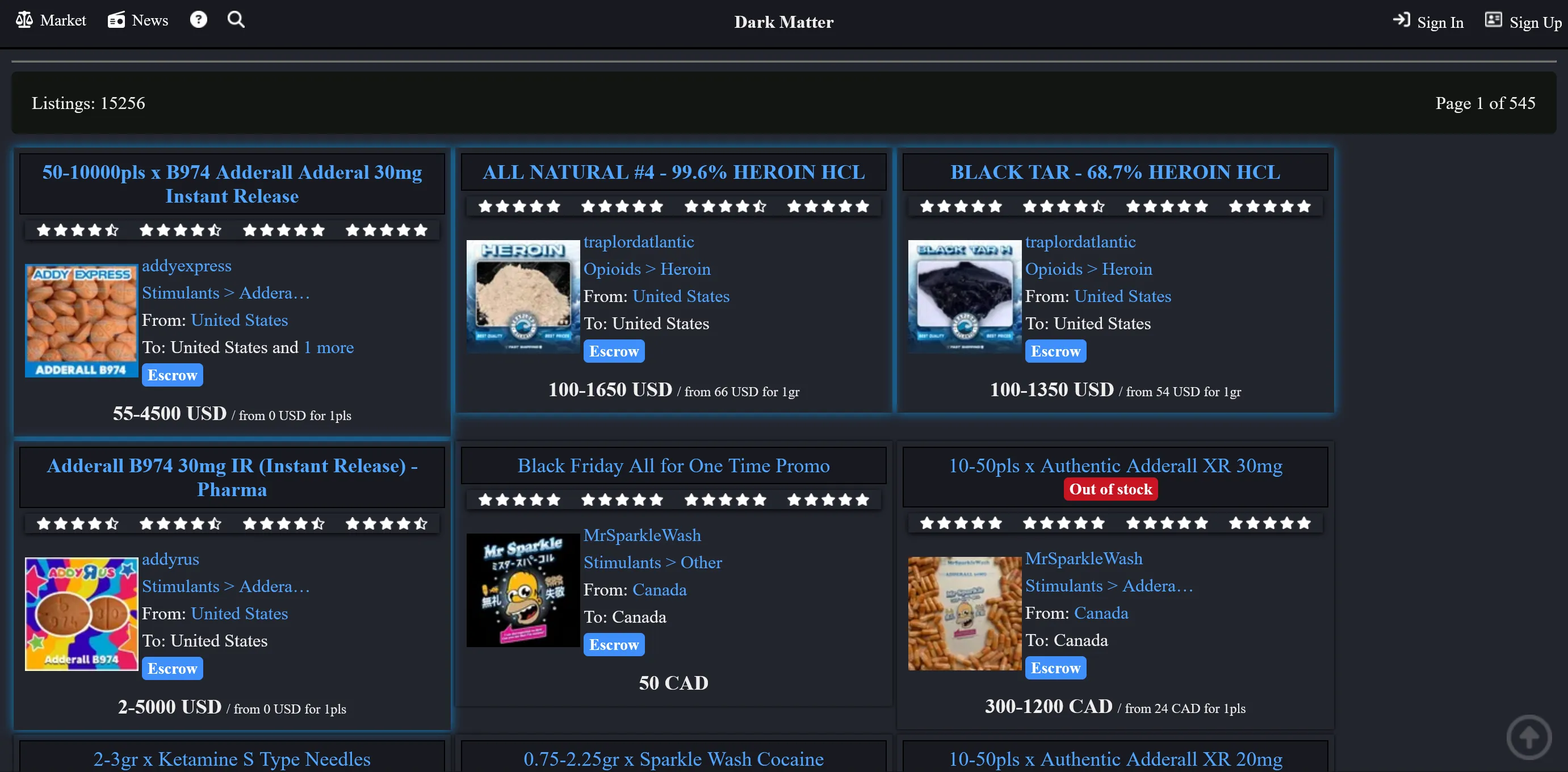
Top-level structure
- Landing page
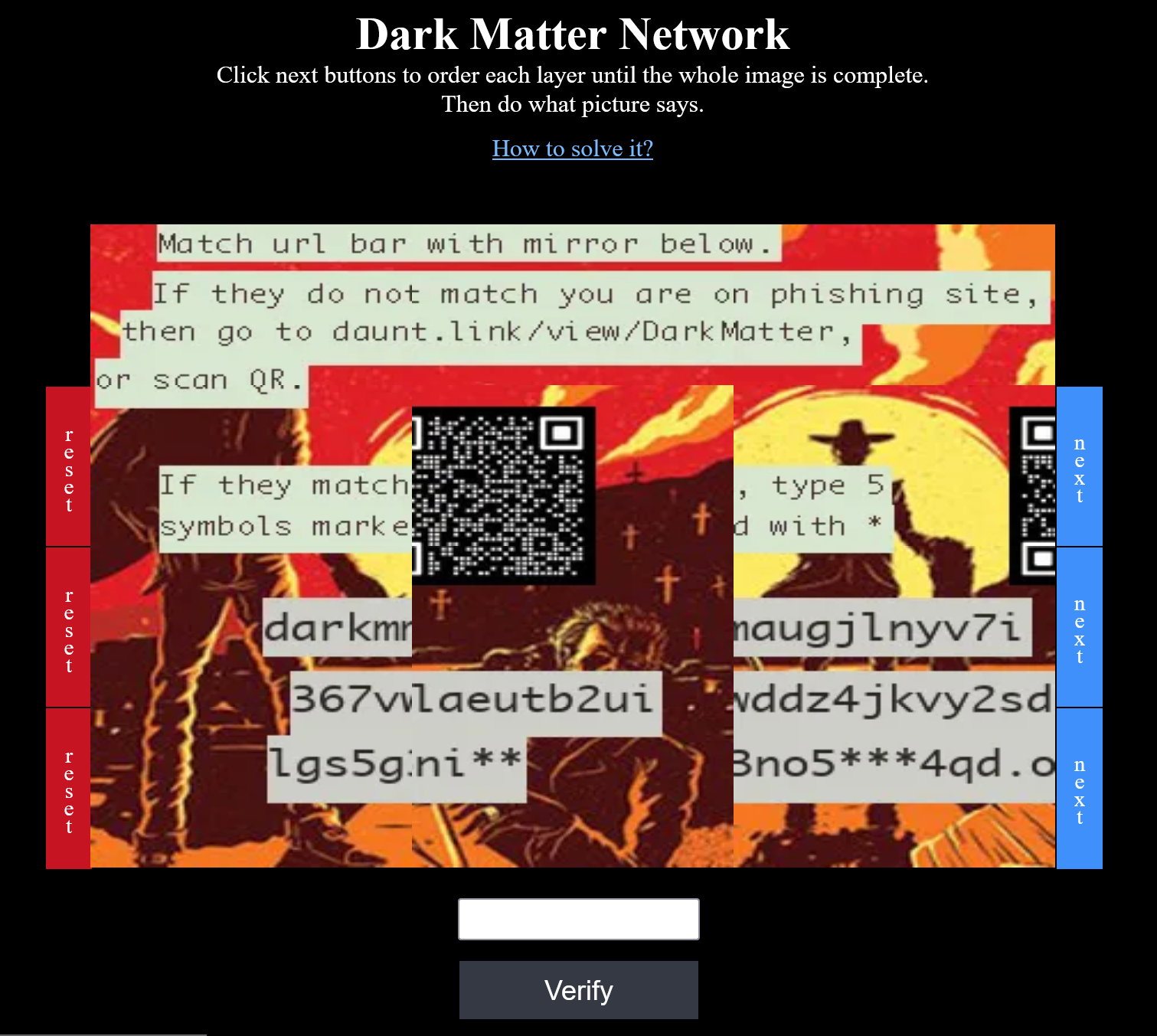
- Sign-in form protected by a custom, phishing-resistant CAPTCHA. The CAPTCHA is the first layer of defence against credential-relay phishing sites.
- Account panel
- Password change, PGP key binding, 2FA toggle, message inbox, and per-order history. Unsophisticated by modern SaaS standards; functional and auditable as a result.
- Category browse
- Listings grouped by category with vendor metadata attached at the row level — vendor name, feedback count, and reputation score surface alongside the listing itself.
- Vendor profiles
- Per-vendor pages showing cumulative feedback, active listings, dispute ratio (where disclosed), and registration age.
- Order flow
- Orders progress through a fixed set of states — placed, funded, shipped, received, finalised — with the corresponding payment address, escrow status, and dispute controls exposed at each stage.
Security architecture — DarkMatter market
Dark Matter does not force security on its users. Most controls — PGP binding, 2FA, encrypted messaging — are optional, turned off by default, and surfaced through prominent nudges rather than hard requirements. The platform provides the tools; whether they get used is on the individual.
Phishing-resistant CAPTCHA
A custom image-based CAPTCHA precedes the login form. Its purpose is to break the automated man-in-the-middle phishing kits that proxy credentials from a lookalike site through to the real one in real time. The CAPTCHA is not a substitute for verifying the correct URL — it reduces the efficacy of one class of attack, not the whole category.
PGP key binding
Accounts can optionally be bound to a PGP public key at registration. Once bound, sensitive account events — password reset, withdrawal confirmation, login from a new session — can be gated on decrypting a challenge issued to the registered key. Pre-registration binding is encouraged but not required.
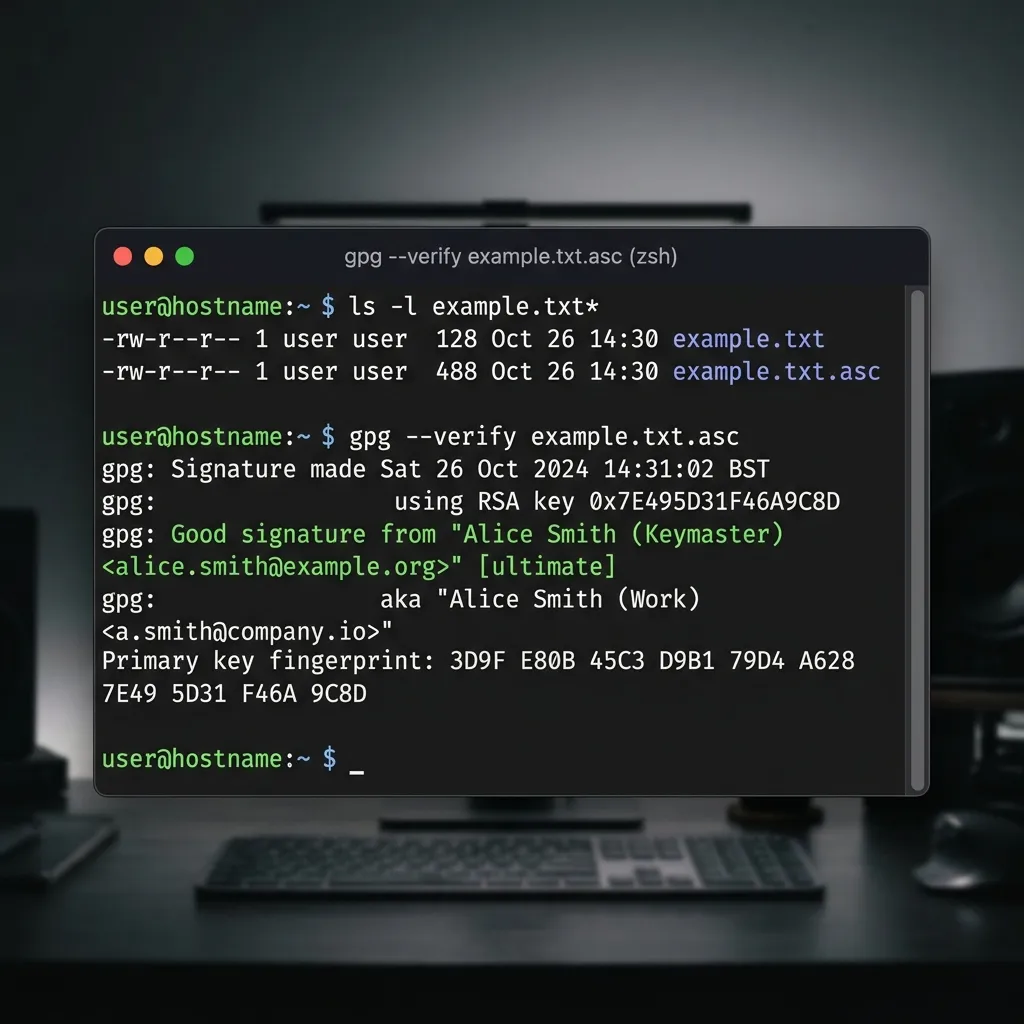
gpg --verify output: a Good signature against an independently obtained
fingerprint is the single-step test that separates the real address from a phishing clone.Two-factor authentication
Time-based one-time passwords (TOTP) are supported through standard authenticator apps (Aegis, andOTP, Authy, etc.). 2FA is off by default and must be manually enabled in the account panel. An additional OTP mode is available for users who prefer a second code scheme; both operate on the standard RFC 6238 time-window convention.
Message-level encryption
Vendor-to-buyer messages are transmitted through the marketplace's own inbox, which means the platform's server is the transport layer. End-to-end encryption of message bodies via the participants' PGP keys is the only protection against a marketplace operator — or any entity with server access — reading order details such as shipping addresses in plaintext. The inbox UI displays explicit PGP warnings when a message is sent without encryption.
Anti-automation and rate-limiting
Login and sensitive-action endpoints are rate-limited; repeated failures trigger session-level throttling. These are standard controls rather than distinguishing features, but their presence is observable in the platform's response patterns.
Mirror diversity on DarkMatter
Multiple signed DarkMatter mirror addresses are published to provide continuity of access during targeted denial-of-service campaigns. Each DarkMatter mirror link shares state with the primary address, so an account signed in via the primary DarkMatter URL is reachable from any of the published mirrors without re-authentication. The current DarkMatter mirror list is PGP-signed in the verified-access section above.
Our technical guide to Tor circuit architecture covers how the network builds these circuits and why hidden services never touch exit nodes.
Payments and escrow — Monero on DarkMatter
Bitcoin is absent from Dark Matter's payment stack. That is a deliberate exclusion, not an oversight — transparent-ledger currencies make chain analysis trivial compared to Monero, and the ecosystem-wide trend has moved away from them since 2020. Dark Matter accepts XMR as its default, with Litecoin and Zcash as per-vendor options, and routes every payment through a fresh per-order deposit address rather than a pooled on-market wallet. Buyers choose between single-signature escrow and optional 2-of-3 multisignature escrow at the order level.
Direct-payment model
Rather than holding a persistent user balance, the platform generates a fresh deposit address for each order. The buyer sends funds directly to that address, the platform confirms receipt, and escrow begins. Because no shared wallet exists on the server, an operator who chose to exit-scam has no pool of customer deposits to abscond with — the structural incentive for that class of attack is markedly lower than on platforms that pool funds.
This does not eliminate risk. Vendor-level fraud, incorrect delivery, and order-level disputes remain the more common sources of loss, and none of them are addressed by the no-pool design. The direct-payment architecture changes the shape of the risk without reducing its total surface.
Single-signature escrow
The default escrow mode. Funds sit in an address controlled by the platform until the buyer marks the order complete, at which point they are released to the vendor. Disputes are mediated by the platform. The platform holds a unilateral ability to release or refund funds — the user's trust is placed in the operator's integrity and dispute process.
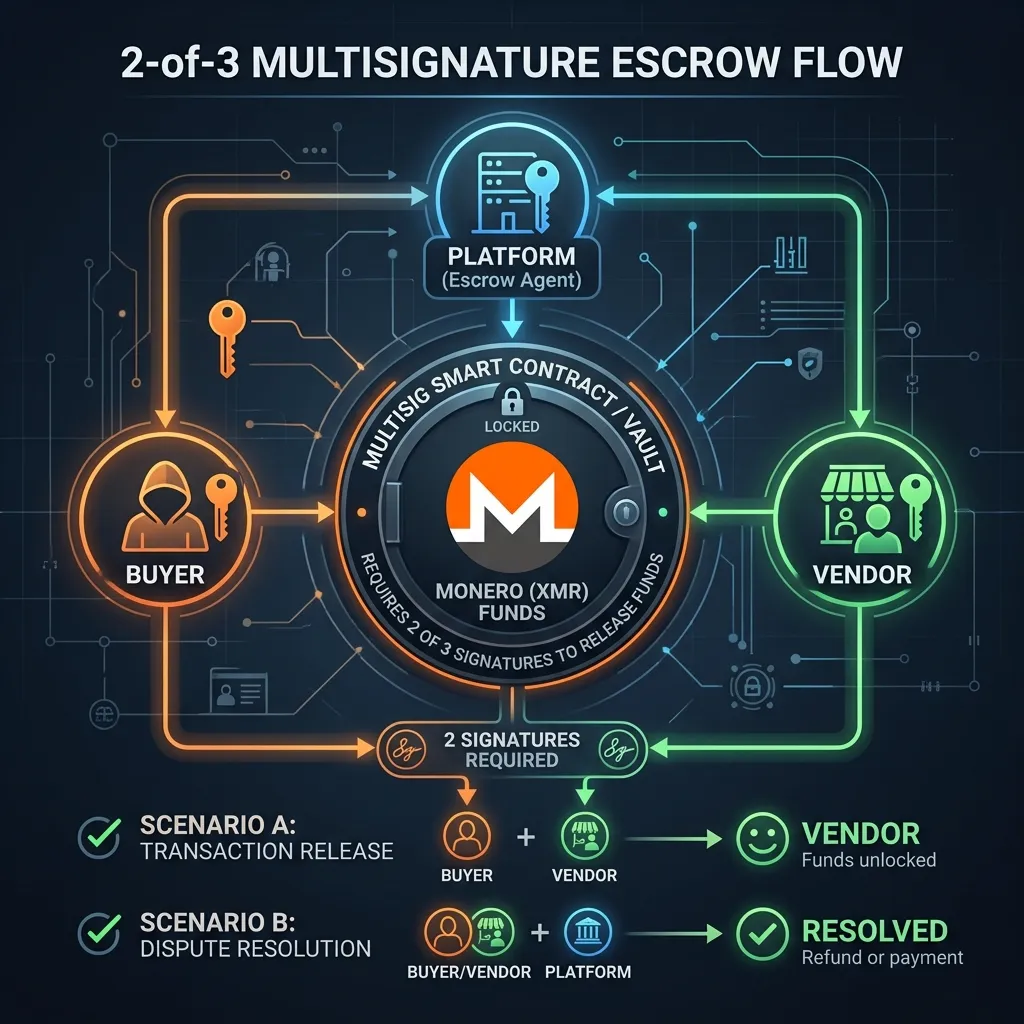
Multisignature escrow (2-of-3)
Optional, and available for higher-value or more cautious orders. Three parties — buyer, vendor, and platform — each hold one key; any two can sign to release or refund funds. The practical effect is that the platform cannot unilaterally seize escrow balances, because a single key is insufficient to move funds. Buyer and vendor together can refund or release without the platform's involvement in the common case, and the platform's key resolves the tiebreak when they disagree.
Supported cryptocurrencies
- Monero (XMR) — default
- Ring signatures, stealth addresses, and RingCT conceal sender, recipient, and amount at the protocol level. XMR is the dominant currency on Dark Matter and on the darknet ecosystem generally. Dependency on Monero is a strong alignment between the platform's privacy claims and its technical stack.
- Litecoin (LTC) — optional
- Faster block times than Bitcoin but a transparent ledger; any privacy comes from mixing or from post-hoc analysis limitations rather than from the chain itself. Acceptance is per-vendor.
- Zcash (ZEC) — optional
- Supports shielded (zk-SNARK) transactions that conceal sender, recipient, and amount, but shielded-pool adoption is comparatively low and most ZEC volume on darknet markets moves through the transparent t-address pool. Acceptance is per-vendor.
The technical details behind ring signatures, stealth addresses, and RingCT are covered in our Monero privacy model explainer.
Vendor trust architecture — DarkMatter darknet
How do you trust a stranger you cannot identify, on a platform you cannot sue, in a jurisdiction that does not apply? Dark Matter's answer is the same stack of overlapping controls that darknet markets have refined since Silk Road: bonds, reputation, escrow, and mediation layered on top of each other.
Vendor bonds
New vendors post a refundable bond that the platform forfeits in the event of sustained fraud, exit behaviour, or rule violations. The bond tilts incentives away from short-term scams that would cost the platform operator a disproportionate reputational hit.
Reputation and feedback
Completed orders generate feedback that accumulates on the vendor profile. Over time this becomes the primary signal a buyer uses to decide who to trust. Feedback is non-removable and cryptographically tied to the order, which makes feedback manipulation more expensive than on platforms with softer review architectures.
Dispute resolution
Disputes open automatically when a buyer does not finalise within a configured window or explicitly raises an issue. Platform mediators review the order history, message log, and evidence provided by both parties. In multisig orders, the platform's key tiebreaks the disagreement only after mediation. In single-sig orders, the mediator's decision is functionally final.
Vendor verification and tiers
Vendor accounts accrue tier status based on completed-order count, feedback quality, and dispute ratio. Higher tiers unlock features like reduced bond requirements or faster listing approval. Tier labels are surfaced on vendor pages and at the listing level.
Finalise-early (FE)
Some vendors request buyers to finalise early — release escrow before receipt. FE bypasses the primary buyer protection and is generally reserved for long-standing high-tier vendors with substantial reputation at stake. For buyers, the standard guidance in the community is that FE should never be granted to new vendors or on high-value orders. This is one of the clearer distinctions between experienced and novice buyers.
How a DarkMatter order progresses
Orders on Dark Matter move through a fixed sequence of states. The flow below is how the escrow-and-reputation system described above works in practice.
- Listing view. The buyer inspects a vendor's listing, vendor profile, feedback history, and dispute ratio before deciding whether to proceed.
- Order placed. The platform generates a per-order deposit address in the vendor's supported currency and opens the order in a pending state.
- Funded. Once the buyer's payment is confirmed on-chain, escrow is formally opened; the funds are held by the platform (or across buyer-vendor-platform keys, in multisig orders).
- Shipped. The vendor marks the order as shipped and supplies any required information through PGP-encrypted messaging.
- Received. The buyer confirms receipt and marks the order complete, at which point escrow releases funds to the vendor.
- Finalised. Feedback is posted to the vendor profile. The order becomes part of the public reputation record.
- Auto-finalise or dispute (alternate paths). If the buyer does not act within a configured window, the order auto-finalises in the vendor's favour. If the buyer raises an issue, the order enters dispute and a platform mediator reviews it.
Runtime milestones — DarkMatter market history
A compact timeline of publicly observable events. Precision is limited by the absence of independently audited marketplace statistics.
- — Launch
- Dark Matter goes live as a Tor hidden service with a minimalist interface and Monero-first payment stack.
- — Early growth
- Vendor count and active listings scale into the thousands. Platform develops a reputation within the darknet-news aggregator circuit as a functional if unpolished option.
- — Multisig rollout
- Optional 2-of-3 multisignature escrow becomes available as an order-level toggle, responding to user preference for lower trust-in-operator.
- — Consolidation
- Active listings cross the 20,000 threshold; user base continues to grow toward the figure reported at time of writing. Mirror diversity expands in response to periodic DoS pressure.
- — Present
- Approximately 95,000 registered users and 26,000 active listings reported. Three-year runtime places the platform in the long-runtime tier of contemporary markets.
None of the above should be read as operational endorsement. Long runtime in this ecosystem correlates with — but does not guarantee — continued stability, and every darknet marketplace in history has eventually ended.
Darknet ecosystem context for DarkMatter
Rather than ranking Dark Matter against other markets — a framing that implies a recommendation — it is more useful to situate it along the axes on which contemporary darknet marketplaces vary.
Longevity axis
Short-lived (months) → medium (1–2 years) → long (2+ years). Dark Matter sits in the long-runtime tier. Longevity is correlated with operational competence but is not a guarantee against any of the three standard end-states.
Custody axis
Pooled-wallet → hybrid → direct-pay. Dark Matter is direct-pay. Custody reduction lowers the platform's unilateral power over user funds and the size of an exit-scam payout, at the cost of slightly more friction per order.
Currency axis
Bitcoin-dominant → multi-currency → XMR-first. Dark Matter is XMR-first, consistent with the ecosystem-wide shift away from transparent-ledger payment rails driven by advances in chain analysis.
UI axis
Retro/minimal → modern/rich. Dark Matter is retro-minimal. This is a stylistic choice with a security-posture benefit — a narrower client-side surface reduces a class of attacks that rich web UIs are more exposed to.
Moderation axis
Laissez-faire → actively curated. Most contemporary platforms including Dark Matter enforce a minimum set of category prohibitions common across the ecosystem. The DarkMatter Watch does not publish a category breakdown as a matter of editorial policy.
Data methodology — DarkMatter statistics
User counts, listing totals, runtime figures, and operational claims quoted throughout this page originate from self-reported marketplace statistics and publicly circulated reporting. None of these figures are independently audited. They should be read as indicative rather than authoritative.
Where possible, we favour ranges and approximations. Where a claim cannot be independently verified, it is introduced as reported or described rather than as established fact. See the about page for the editorial standards this site applies and the status page for uptime, mirror health, and the incident log.
Frequently asked questions about DarkMatter
The questions below are the ones readers actually land on this page to answer.
- What is the DarkMatter market URL?
- The canonical DarkMatter URL is published in the verified-access section above as a PGP-signed onion link. It is the only DarkMatter market URL signed by the operator's key — any other DarkMatter link encountered in search results, DMs, or paste sites should be treated as a phishing clone until independently verified. Bookmark the verified DarkMatter darknet URL after confirming the PGP signature.
- Where do I find the DarkMatter onion link?
- The DarkMatter onion link (a v3 Tor
.onionaddress) is published here under a PGP signature together with two backup DarkMatter mirror addresses. Before trusting any DarkMatter onion URL, verify the signature against a fingerprint obtained from at least two independent sources — the five-step process is detailed in the verified-access section. Each DarkMatter mirror link should also be verified the same way. - Is DarkMatter on the dark web or the darknet?
- Both terms describe the same thing in this context. The DarkMatter darknet marketplace is a Tor hidden service — reachable only through the Tor network using its v3 onion address — which places it in what is colloquially called the dark web or darknet. It is not accessible via a regular clearnet browser; access requires a verified DarkMatter link opened in the Tor Browser.
- Is the DarkMatter dark web market the same as the DarkMatter darknet market?
- Yes. "Dark web" and "darknet" are interchangeable labels for Tor hidden services in common usage. The DarkMatter marketplace is one platform reachable via its canonical DarkMatter onion URL, whether you call it a dark web market or a darknet market. The verified link is published above under a PGP signature.
- How do I tell a real DarkMatter link from a fake one?
- Compare the candidate DarkMatter URL character-for-character against the PGP-signed DarkMatter onion URL on this page, and verify the signature locally with a fingerprint obtained independently. Any DarkMatter link or DarkMatter mirror link that fails either check is a phishing clone. The same applies to every DarkMatter Tor address you encounter anywhere.
- What is DarkMatter?
- DarkMatter is a Tor-based multi-vendor DarkMatter darknet market that launched in late 2022. It has grown to roughly 95,000 registered users and 26,000 active listings, with Monero (XMR) as its default payment currency and optional 2-of-3 multisignature escrow. Access requires the Tor Browser and a verified onion address.
- Is this website affiliated with the marketplace?
- No. DarkMatter Watch is an independent, non-commercial reference site. We do not operate, represent, or receive compensation from Dark Matter or any other darknet platform.
- Why publish an onion address at all if the site is "descriptive only"?
- Because phishing is the single largest source of financial loss in this ecosystem, and a PGP-signed canonical address is the standard harm-reduction countermeasure. A reader who would have encountered the platform anyway is safer encountering a verified address on a signed reference page than a lookalike pushed through a search engine or a stranger's forum post.
- How do I verify the address is real before I trust it?
- Follow the five-step process in the verified-access section:
obtain the fingerprint from multiple independent sources, import the public key,
gpg --verifythe signed block, cross-check the URL against two other signed mirror lists, and never accept an address handed to you in a DM. - What stops the marketplace from just running away with deposits?
- Structurally, the absence of a pooled on-market wallet. The platform generates per-order payment addresses rather than holding user balances, which removes the pool that would otherwise be the target of an exit scam. Vendor-level fraud and order-level disputes remain the more common loss vectors.
- Is Monero actually private, or is that marketing?
- Monero's ring signatures, stealth addresses, and confidential-amounts design provide protocol-level privacy that Bitcoin and Litecoin do not have. It is not unbreakable — no privacy technology is — but it raises the cost of chain analysis by orders of magnitude compared to transparent ledgers, which is why XMR has become the default on contemporary darknet markets.
- Does Dark Matter require 2FA or PGP?
- Neither is mandatory at registration, but both are strongly encouraged and the UI surfaces warnings when messages are sent unencrypted. Time-based OTP via standard authenticator apps is available. PGP key binding is optional but gates some account events behind key-challenge verification when enabled.
- What is finalise-early and why does it matter?
- FE is releasing escrow before receiving an order — it bypasses buyer protection. The consensus guidance is that FE should never be granted to new or low-reputation vendors and never on high-value orders. Requests for FE from unestablished vendors are one of the clearest red flags in the ecosystem.
- How long has DarkMatter been running?
- The DarkMatter darknet market has been running for just over three years as of 2026. This places the DarkMatter marketplace in the long-runtime tier of contemporary darknet marketplaces — an ecosystem in which the median platform lifespan is closer to a year before seizure, exit scam, or voluntary shutdown.
- Where can I learn more or submit a correction?
- Live reachability, uptime, and the incident log are on the status page, editorial standards on the about page, and corrections via the contact page — PGP-encrypted if preferred.