
How Tor protects hidden services
Every Tor hidden service, including the DarkMatter market, operates through a circuit architecture that keeps both the client's IP address and the server's IP address hidden from each other. This page explains how those circuits are built, why hidden services never touch exit nodes, and what happens when someone tries to knock a hidden service offline.
Standard Tor circuits: the three-hop model
When you open Tor Browser and visit a normal website (say, Wikipedia), Tor builds a three-hop circuit between your machine and the destination. The circuit passes through three relays, each operated by a different volunteer:
Guard node. The first relay in the circuit. Your ISP can see that you connected to this relay, but all it sees is encrypted traffic going in. The guard knows your real IP address. It does not know what you are requesting or where the traffic ends up.
Middle relay. The second hop. The middle relay knows the guard's address and the exit's address. It knows nothing else. It cannot read the traffic because it is still wrapped in a layer of encryption meant for the exit.
Exit node. The last relay in the circuit. The exit strips the final layer of encryption and sends your request to the destination server in cleartext (or in TLS, if the destination uses HTTPS). The exit can read unencrypted traffic, but it has no idea who sent it because all it sees is the middle relay's address.
The word "onion" comes from this layered encryption. When your Tor client builds a circuit, it wraps the original request in three layers of encryption, one for each relay. Each relay peels one layer, reads the next hop address, and forwards the remaining layers. Nobody in the chain sees both ends: the guard knows who you are but not where you are going, and the exit knows where you are going but not who you are.
This is fine for visiting clearnet websites through Tor. But hidden services have a different problem. The server itself also needs to stay anonymous. An exit node would expose the server's IP address, which defeats the point. So hidden services do not use exit nodes at all.
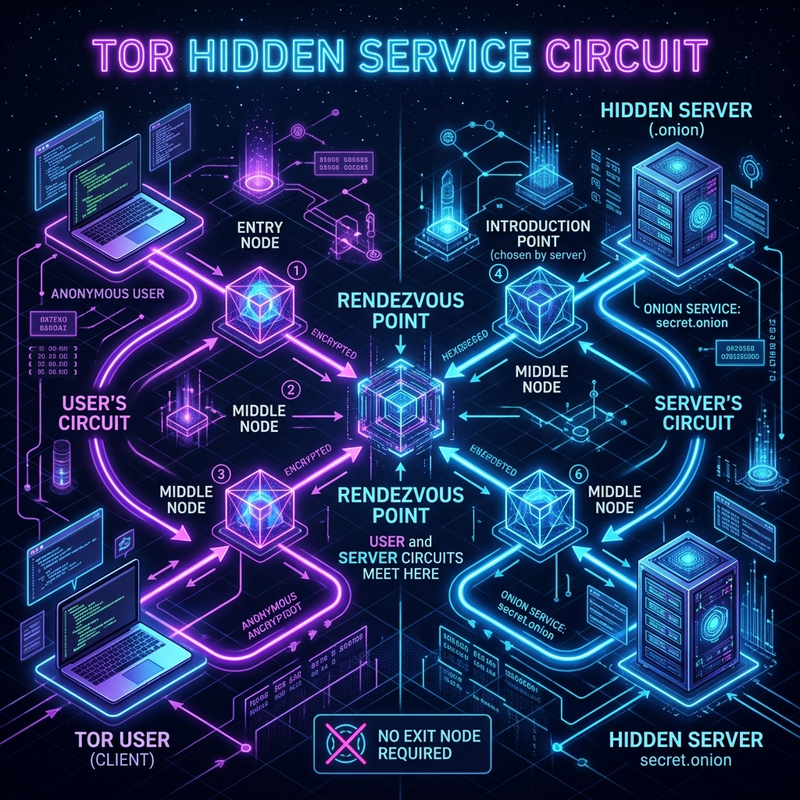
Introduction points and descriptors
Before a client can reach a hidden service, the service has to advertise where to find it. But "where" in this context does not mean an IP address. It means a set of Tor relays willing to act as introduction points.
Here is how it works in sequence:
The hidden service picks a few Tor relays and establishes persistent circuits to each of them. These are its introduction points. The service then publishes an encrypted descriptor to a distributed hash table (DHT) inside the Tor directory system. The descriptor contains the introduction points' addresses and the cryptographic material a client needs to start a connection.
The descriptor is encrypted with a key derived from the service's onion address.
This means you need to already know the .onion address to decrypt
the descriptor. You cannot browse the DHT and discover hidden services by
accident. This is by design.
When a client wants to reach the service, it fetches the descriptor from the DHT, decrypts it, and picks one of the listed introduction points. The client then builds a circuit to a rendezvous point (a random Tor relay the client chose) and sends a message through the introduction point asking the service to meet at that rendezvous.
The service receives the request through its introduction-point circuit, builds a new circuit to the specified rendezvous point, and the two circuits are joined. From this point on, all communication flows through the rendezvous point.
The introduction point never carries actual traffic. Its only job is to forward the initial "please meet me at this rendezvous" message. After that, it is no longer involved.
Why hidden services go offline: DDoS on the Tor layer
Between 2023 and early 2025, the Tor network experienced sustained denial-of-service attacks that targeted hidden services specifically. Multiple darknet markets, including those in DarkMatter's tier, were intermittently unreachable for days at a time. The attacks were not aimed at the server's IP address (which the attacker did not know). They targeted the Tor infrastructure around the service.
Flooding introduction points
The simplest attack is to flood the introduction points with connection requests. Each request triggers a descriptor lookup, a circuit build, and a rendezvous negotiation. These are not cheap operations on the Tor network. A few thousand requests per second can exhaust the introduction points' capacity and make the service unreachable to real clients.
The service can rotate to new introduction points, but the attacker can follow by fetching the updated descriptor. It becomes a game of whack-a-mole that the attacker usually wins because flooding is cheaper than circuit building.
Directory-level attacks
A more sophisticated variant targets the distributed hash table where descriptors are stored. By flooding the DHT nodes responsible for a particular onion address, the attacker can prevent clients from fetching the descriptor in the first place. No descriptor means no introduction points, which means the service might as well not exist.
Guard discovery
If an attacker can identify the hidden service's guard node, they can attack that specific relay. Guard nodes are chosen for long-term stability (Tor assigns them for weeks or months to resist certain correlation attacks), which means taking out one guard can break the service's connectivity for a while. The Tor Project has made guard selection more resistant to discovery over successive protocol versions, but the attack surface is not fully closed.
Proof-of-work rate limiting (Tor 0.4.8 and later)
The DDoS waves of 2023 forced the Tor Project to ship a defense mechanism that had been discussed for years: client-side proof of work for hidden service connections.
Starting with Tor version 0.4.8 (released June 2023), hidden services can require connecting clients to solve a computational puzzle before the introduction point will forward their request. The puzzle uses the EquiX algorithm, which is designed to be hard to parallelize on GPUs but runs quickly on a normal CPU.
The difficulty adjusts automatically. Under normal load, the puzzle takes a few milliseconds and the user does not notice. Under attack, the service increases the difficulty. A legitimate user solving one puzzle at high difficulty might wait a few seconds. An attacker trying to generate thousands of connection requests per second has to burn proportionally more CPU, which makes the attack expensive enough to discourage or at least throttle.
The system is not perfect. Attackers with access to large botnets can still generate enough puzzle solutions to maintain pressure. And the difficulty ramp-up can cause slowdowns for legitimate users during an attack. But the Tor network's DDoS resilience improved measurably after 0.4.8 rolled out, based on the decreased frequency and duration of hidden-service outages reported across the network in 2024.
What mirroring means for hidden services
When a marketplace like DarkMatter publishes multiple onion addresses (a primary address and two mirrors), each address is a separate hidden service with its own Ed25519 keypair and its own set of introduction points. All of them connect back to the same web server, but from the Tor network's perspective they are independent services.
The point of mirroring is redundancy against DDoS. If an attacker targets the primary address's introduction points, the mirrors may remain reachable because they use different introduction points. The attacker would need to flood all three services simultaneously, which triples the cost.
Mirroring also creates a verification problem. A user who finds a mirror address needs to confirm it was published by the same operator, not by a phishing attacker. The standard solution is PGP: the operator signs all canonical addresses with the same PGP key, and users verify each mirror against the operator's published fingerprint.
The verified-access section on our homepage publishes the three signed addresses for the DarkMatter onion URL in this format. The status page monitors reachability across all three.
What Tor does not protect against
Tor hides IP addresses. That is it. It does not protect against:
Application-layer leaks. If a hidden service runs a web application with a vulnerability that leaks its hostname, internal IP, or filesystem path in an error message, Tor cannot fix that. The 2013 Freedom Hosting takedown exploited a Firefox JavaScript vulnerability that revealed users' real IP addresses despite the Tor circuit being intact.
Operational security failures. If the server operator logs into the same email address from the server's real IP and from a Tor-protected session, the correlation is trivial. Ross Ulbricht (Silk Road) was identified partly through forum posts made from his home IP address in the early days of the project, before he started using Tor consistently.
Traffic correlation at scale. An adversary that controls or monitors both the guard relay and the destination (or, for hidden services, both guards) can correlate traffic timing to deanonymize the connection. This requires significant infrastructure, but national-level agencies have the resources. A 2024 investigative report by Panorama and STRG_F documented cases where German law enforcement performed timing analysis against Tor users by operating their own relays over a period of months.
Consensus-level attacks. If an attacker controls enough directory authorities or HSDir nodes, they can manipulate descriptor availability or relay selection. The Tor Project's design limits this by distributing trust across multiple authorities, but the attack surface exists in theory.
None of this means Tor is broken. It means Tor has a specific threat model, and it works within that model. Problems arise when people assume it covers things it does not.
Further reading
For the marketplace-specific context of how Tor hidden services are used in practice, see the security architecture section on the homepage. The status page tracks endpoint reachability and documents incidents where the DarkMatter onion URL or its mirrors experienced degraded access.
The Tor Project publishes its own specification documents covering the rendezvous protocol (rend-spec-v3), directory protocol (dir-spec), and the proof-of-work proposal (prop327). These are dense but complete.
For editorial standards and corrections, see the about page.
Primary sources & further reading
- Dingledine, R., Mathewson, N., & Syverson, P. (2004). Tor: The Second-Generation Onion Router. USENIX Security 2004. tor-design.pdf
- Tor Project. Tor Rendezvous Specification — Version 3. spec.torproject.org/rend-spec-v3
- Tor Project. Tor Directory Protocol, version 3. spec.torproject.org/dir-spec
- Tor Project. Proof-of-Work Defense for Onion Services — Proposal 327. spec.torproject.org/proposals/327